As your high schooler navigates the exciting yet sometimes daunting path toward college admissions, Advanced Placement (AP) exams often play a significant role. These exams offer students the chance to earn college credit and demonstrate their academic prowess. But beyond just taking the exams, understanding the score distributions can provide valuable insights for both you and your student as you plan their academic journey. Let’s delve into the 2025 AP score distributions for Math & Computer Science and the various Science subjects.
Math & Computer Science
Looking at the 2025 data for Math & Computer Science, some clear trends emerge. AP Calculus BC stands out with an impressive 44% of students scoring a 5, and a combined 79% scoring a 3 or higher. This suggests that students who take on the challenge of Calculus BC are often well-prepared and achieve high marks. AP Precalculus also shows strong performance, with 28% earning a 5 and a remarkable 81% scoring 3 or higher, indicating its effectiveness as a foundational course. In contrast, AP Computer Science Principles and AP Statistics have lower percentages of 5s (11% and 17% respectively) and also lower percentages of students scoring 3 or higher (63% and 60%), which might suggest these exams present unique challenges or attract a broader range of students.
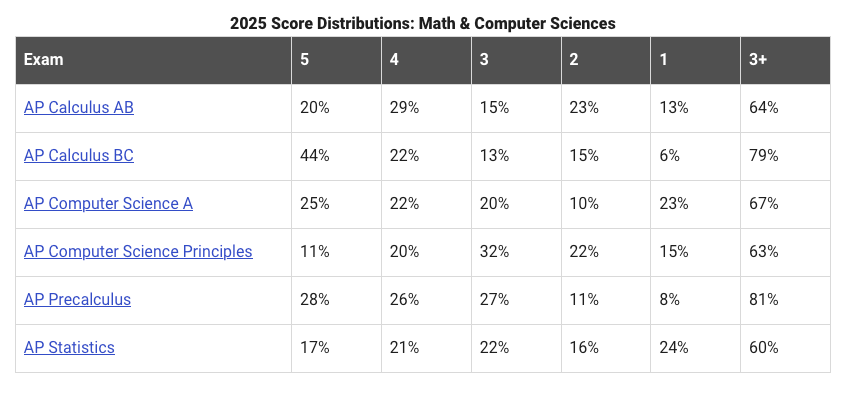
Image courtesy: College Board
Sciences
Shifting our focus to the Science disciplines, the score distributions offer another interesting perspective. Exams like AP Physics 2 and AP Physics C: Electricity and Magnetism show a respectable 20% and 23% of students earning a 5, respectively, with solid passing rates (72% for both scoring 3 or higher). AP Biology and AP Chemistry also demonstrate strong outcomes, with 19% and 17% achieving a 5, and 71% and 78% scoring 3 or higher, respectively. These figures suggest consistent performance across these core science subjects, reflecting the rigor of the curricula and the dedication of the students.
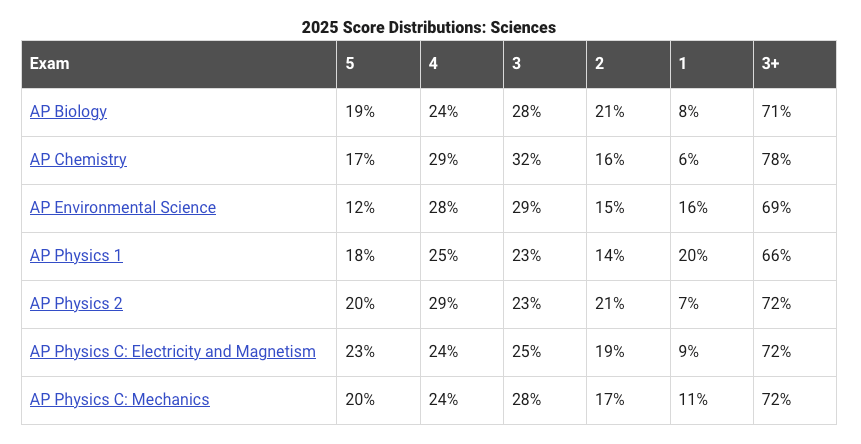
Image courtesy: College Board
It’s worth noting some variations within the sciences. AP Environmental Science, while still having a decent passing rate of 69% (3 or higher), has a lower percentage of 5s at 12%. Similarly, AP Physics 1 shows 18% earning a 5, but a slightly lower 66% scoring 3 or higher, and a higher percentage of 1s and 2s compared to some other science exams. This isn’t to say these courses are less valuable, but understanding these distributions can help you and your student set realistic expectations and potentially tailor their study strategies based on the historical performance on these specific exams.
Beyond AP Scores
These AP score distributions are more than just numbers; they are a snapshot of how students are performing nationally and can serve as a helpful guide. While a high score is certainly beneficial, remember that colleges also look at the overall context of a student’s academic record, the rigor of their coursework, and their extracurricular involvement. Encourage your student to choose AP courses that align with their interests and future academic goals, and support them in their preparation, knowing that every effort they put in is building a strong foundation for their college journey.
Contact Future Forward today to unlock your student’s potential for college admissions.
 Back
Back 
Leave a comment