As regional and state competitions intensify, the question shifts from “Is my project interesting?” to something far more important:
Can I defend it like a scientist?
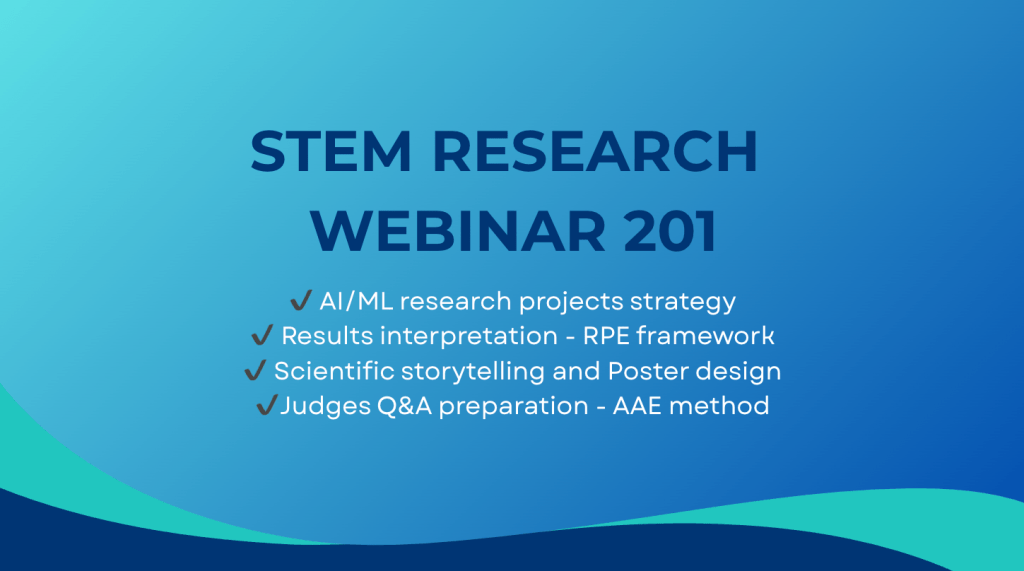
In our latest webinar, STEM Research 201, hosted by Future Forward Labs, we moved beyond idea generation and into what actually separates strong projects from award-winning ones: interpreting results, introducing real novelty in AI/ML research, and communicating findings with confidence.
If you’re navigating competitive science education—or searching for experienced science fair mentors—this session offered a clear map of what matters now.
🎥 Watch the Full Webinar Recording
The AI/ML Illusion: Why “Training a Model” Isn’t Enough Anymore
A few years ago, training an existing neural network on a new dataset was considered innovative. Today, it’s commoditized.
Judges at high-level competitions—including events that feed into Regeneron International Science and Engineering Fair—have seen hundreds of projects built on transfer learning. Competing on dataset size or compute power simply isn’t realistic when industry labs operate at enterprise scale.
Instead, novelty now lives in how you formulate the problem.
Students were encouraged to:
- Apply existing models to unconventional domains (music, robotics, biomechanics).
- Transpose problems across modalities (e.g., convert audio to visual representations to leverage computer vision strengths).
- Introduce domain-specific feature engineering that produces measurable improvements.
- Constrain models using physics, probability, or biological principles.
In one case study, degraded cassette audio was restored not by “training a better model,” but by reframing the signal into a visual waveform and applying computer vision logic. In another approach, harmonic physics constrained the model’s predictions, reducing ambiguity before machine learning even began.
The takeaway for students exploring AI science fair projects or machine learning competition topics is simple:
You don’t win by building bigger models. You win by thinking differently about the problem.
This is precisely where structured science research mentorships make a difference, guiding students to refine formulation rather than chase scale.
Statistical Rigor Is No Longer Optional
Claiming a “3% improvement” means nothing without statistical validation.
Your science research project is expected to have:
- Clear baselines
- Defined comparison groups
- P-values or statistical evidence
- Honest discussion of limitations
Even middle school students are allowed and encouraged to discuss standard deviation and statistical significance. Research means stepping beyond the standard curriculum.
In competitive science education, clarity and rigor matter more than complexity.
When Results Don’t Match Expectations
Dr. Delia DeBuc reframed one of the most misunderstood aspects of student research: failure.
In real science, unexpected results are not a setback, they’re information.
Judges are silently asking three questions:
- What did you expect?
- What did you observe?
- How do you explain the difference?
To answer clearly, students were introduced to the Result–Pattern–Explanation (RPE) framework:
- Result: What happened in a specific trial?
- Pattern: What happened consistently across trials?
- Explanation: Why did it happen, based on scientific reasoning?
For example, an AI model performing poorly under varied lighting conditions isn’t a failure, it reveals a training data limitation. That insight becomes the real contribution.
Projects become stronger when students:
- Identify anomalies
- Acknowledge weaknesses
- Propose future refinements
Honest error analysis builds credibility. Intellectual maturity gets rewarded.
Presentation Is Scientific Communication, Not Performance
A strong project can lose momentum if poorly communicated.
Students were advised to structure posters like a guided research journey:
- The big question
- Why it matters
- Clear methodology
- Visualized results
- Limitations and future work
If a science enthusiast can understand the core finding within 10–15 seconds, you’ve nailed your presentation!
Equally important is the Q&A. The recommended approach, Acknowledge, Answer, Extend (AAE), ensures responses are thoughtful rather than reactive. Paraphrasing the question buys clarity and thinking time. Admitting uncertainty, when paired with how you would investigate further, demonstrates growth.
This level of preparation is why experienced science fair mentors emphasize defense training, not just experimentation.
Personal Challenges Create Powerful Projects
Perhaps the most compelling insight from the session was this: big companies chase massive global problems. Students can win by solving personal ones.
One highlighted example involved a student who combined rowing and computer vision to build a real-time feedback system that improved team performance by three seconds. The strength wasn’t just technical—it was personal, interdisciplinary, and measurable.
Another student analyzed shifts in language trends in university publications and published findings without ever entering a science fair. The research itself became the distinguishing factor.
Competition-based search phrases like “award-winning science fair ideas” often imply scale. In reality, judges look for ownership, clarity, and spark.
The Real Purpose of Research
While competitions and college admissions are important, research does something deeper.
It teaches students to:
- Handle ambiguity
- Interpret incomplete data
- Defend ideas logically
- Communicate complex reasoning clearly
That transformation is what high-quality science education aims to cultivate.
Science research mentorships are not about scripting projects step-by-step. They are about helping students discard weak formulations early, navigate roadblocks, and build intellectual independence.
Moving Forward
As science fair season advances into higher-stakes rounds, the differentiator is no longer the topic, it’s the depth of thinking behind it.
If you’re looking for:
- Science fair mentors who focus on statistical rigor and defense
- Guidance on AI/ML research positioning
- Support interpreting complex results
- Structured science research mentorships for competitive environments
We invite you to explore how mentorship can sharpen not just the project, but the scientist behind it.
Watch the full webinar above, and join us for the next session as we continue unpacking what competitive research truly demands.
 Back
Back 
Leave a comment